Showing posts with label politics. Show all posts
Showing posts with label politics. Show all posts
Monday, June 4, 2012
Pakistani doctor who helped US appeals verdict
Islamabad, Pakistan (CNN) -- The Pakistani doctor who helped the United States locate Osama bin Laden's compound is appealing a treason conviction that landed him a 33-year jail sentence.
The sentence against Shakeel Afridi has further strained U.S.-Pakistani relations, but court documents say the doctor wasn't convicted for helping the CIA. He was punished for having ties to extremists, the documents show.
The court found Afridi guilty of providing financial and medical assistance to the now defunct militant group Lashkar-e-Islam.
Afridi's lawyer, Samiullah Afridi, told CNN Saturday that he filed an appeal against the verdict.
The Khyber Agency court said Shakeel Afridi had "close links" with Lashkar-e-Islam, which operated in the Khyber tribal areas, and its leader Mangal Bagh.
Afridi's brother, Jamil Afridi, said last week that the allegations are false and the family is worried. Shakeel Afridi has been in custody for more than a year.
Jamil Afridi said the court accused his brother of helping Mangal Bagh but that it was the militant leader who kidnapped the doctor for ransom money.
©CNN's Nasir Habib
http://edition.cnn.com/2012/06/02/world/asia/pakistan-bin-laden-doctor/index.html?hpt=ias_c2

Official: 15 militants killed in suspected U.S. drone strike in Pakistan

(CNN) -- A suspected U.S. drone strike in northwestern Pakistan on Monday morning killed 15 militants and wounded three others, a local government official said, the third such deadly attack in as many days.
The drone fired at least six missiles at a militant compound near the town of Mir Ali in the North Waziristan region near the Afghanistan border, government official Muhammad Amir told CNN.
North Waziristan is one of seven districts in Pakistan's tribal region. The area is widely believed to be the operating base for the Haqqani network and other militant groups that have attacked international troops in neighboring Afghanistan.
Monday's attack is the 21st suspected drone strike in Pakistan this year. U.S. officials rarely discuss the CIA's drone program in Pakistan, though privately they have said the covert strikes are legal and an effective tactic in the fight against extremists.
Wisconsin recall campaign winds up

(CNN) -- Wisconsin Gov. Scott Walker, a Republican hero for pushing austerity measures that stripped collective bargaining rights from most public unions, rallied supporters Monday night, one last push before a recall that's drawn lots of outside interest and money.
"We can't spike the ball on the 10-yard line. We've got to take it all the way into the end zone," Walker said in a Green Bay restaurant, within walking distance of the Packers' famed Lambeau Field. "Because when we do it's a win not just for us. It's a win for our kids and grandkids to make sure they have a better future than the one we inherited."
Walker faces Milwaukee Mayor Tom Barrett on Tuesday in a rematch of the 2010 governor's race that he won by getting more than 52% of the vote.
This time, the stakes are higher after a vitriolic campaign that epitomized the political divide across the country.
Viral Web's 'Mr. Trololo' dies at 77
(CNN) -- Eduard Khil, a Soviet-era singing star who found renewed popularity as the viral Web's "Mr. Trololo," died Monday, Russian media reported.
Khil had been in a St. Petersburg, Russia, hospital since suffering a stroke in April. He was 77.
Khil was considered one of the Soviet Union's great performers in the '60s and '70s. But his claim to fame in the rest of the world came in 2009 after a YouTube video posting of him performing the Russian pop song "I Am Glad, 'Cause I'm Finally Returning Back Home."
With a toothy grin, Khil delivers a clearly lip-synced performance minus lyrics, instead using a series of made-up syllables, including the "trololololo" that captured the hearts of millions.
According to New Music Express, the original lyrics, about a cowboy riding his horse home to meet his sweetheart Mary, were censored because they were deemed "un-Soviet." That led to his "mouth music" version, which ends up sounding like a mash-up of yodeling and jazz-era scat singing over a cheesy orchestral arrangement.
Groupon now worth less than the $6 billion Google offered

NEW YORK (CNNMoney) -- Andrew Mason could probably use a Groupon for a massage, a beer, or some comfort food right about now.
His company's precipitous stock decline continued on Monday, sending Groupon's market cap below the $6 billion that Google offered as a buyout in late 2010.
To cut 1,700 jobs, Verizon offers buyouts

The company is looking to lower costs in certain areas of its traditional wireline division, which saw a decline in the first quarter.
Sunday, May 20, 2012
UDD waits on Pheu Thai to bring justice
UDD waits on Pheu Thai to bring justice
Published: 19/05/2012 at 03:26 AM
After more than nine months under their "own government", some red shirts still feel their basic problems have not yet been addressed despite general improvements elsewhere.
Not only structural problems such as poverty and land rights, but also the "justice" that Luen Srisupo, 48, and his red shirt colleagues sought have not been granted by their own government.
Mr Luen was a red shirt leader in Sakon Nakhon. Two years ago, when the red shirts staged rallies in Bangkok and many provinces in the Northeast and North, he was a key speaker in his hometown. And one of his key points was social injustice.
After the Abhisit Vejjajiva government ordered a crackdown, Phang Khon police issued an arrest warrant for Mr Luen, and he is still on the run despite Pheu Thai being in power.
One of his fellow activists Sakrapee Promchart was arrested and imprisoned for eight months. Mr Luen fled as he believed he did nothing wrong and only exercised his freedom of speech.
Now Sakrapee is running for the presidency of Sakon Nakhon provincial administrative organisation, while Mr Luen is just running.
Mr Luen feels he has not been given justice by the Yingluck Shinawatra government, and believes the administration has done nothing to address the problem nationwide since it was voted in on July 3 last year.
In March 2010, Mr Luen spoke at a Chulalongkorn University academic forum and said that while land and water as well as wages and environmental problems were the main agenda for the poor, the grassroots needed to re-prioritise and set politics right first.
"Now we get our own government, but this government has yet to work on the poor agenda. People feel the government might be not different from previous administrations - they do not take care of the core issues of the rural people," said Mr Luen.
"Influential capitalists with local political connections can farm on a much bigger scale on land that was acquired dubiously with the help of the authorities. Double standard remains and realities bite us hard."
Veerasak Saenklang, Khon Kaen chair of the United Front for Democracy Against Dictatorship (UDD), insists that rural red shirts are satisfied Pheu Thai is in power after years of struggle, but they were getting more disappointed that it does not address the justice problems.
"Lawsuits regarding the political crackdown are still slow. Some detainees have yet to get bail," he said.
"Hundreds of people in each affected province have yet to be freed from non-functional arrest warrants. Also, Jatuporn Prompan was denied MP status. These are the double standards we have been fighting against, but they're still there."
He said villagers have been questioning the ongoing injustice; for example the recent death of elderly lese majeste convict Ampon Tangnoppakul .
"Of course, they don't discuss Section 112 [the lese majeste law] much as they realise it's a sensitive issue involving the revered institution of Thailand. But they feel that the lese majeste lawsuit has been somehow politically abused," said Mr veerasak.
He said villagers were angry senior PAD figure Sondhi Limpthongkul had his lese majeste sentence reduced and was bailed, while Ampon died in a prison hospital.
While red shirts from the Northeast will join the Bangkok commemorations of the Ratchaprasong crackdown today, some prefer to stay put, holding commemorations in their own provinces.
The future of the red shirt movement is not only being debated in the capital - sympathisers and supporters in the provinces are also uncertain of its future.
©bangkokpost
http://www.bangkokpost.com/news/politics/294067/udd-waits-on-pheu-thai-to-bring-justice
Charter court disqualifies Jatuporn

Charter court disqualifies Jatuporn
Published: 18/05/2012 at 05:14 PM
The Constitution Court on Friday disqualified Jatuporn Prompan as a Pheu Thai Party list MP on the grounds that his membership of the party was voided when he was jailed.
The court judges voted seven to one to strip Mr Jatuporn of his status as an MP.
The Election Commission on Nov 29, 2011 ruled to disqualify him for not voting in the general election on July 3 last year.
The EC at the time voted four to one to disqualify Mr Jatuporn, a core member of the red-shirt United Front for Democracy against Dictatorship (UDD), who was detained in prison when the election took place and unable to vote.
The commission then forwarded Mr Jatuporn's case to the Constitution Court for final approval.
After the charter court issued its verdict topday about 100 red-shirts who gathered outside the court in a show of support jeered and expressed their disappointment.
Mr Jatuporn, who was in tears, told reporters that he must keep his feelings about being treated unjustly to himself.
"I've always been fighting against injustice and I accept my own fate because the path is not strewn with roses," he said. "I would like to apologise to the people, especially the red-shirt people, for bringing distress to them."
"From now on, I'm a full citizen [with no MP immunity] but my heart is still a red-shirt. I will register with the Pheu Thai Party and will continue fighting against injustice," Mr Jatuporn said.
Nattawut Saikuar, a Pheu Thai list MP and also a UDD co-leader, said the court's ruling had stripped Mr Jatuporn of his MP seat, but not of his "democratic spirit".
"Today, I and my red-shirt brothers and sisters will stand side by side but we'll have to persevere with the pain and allow today's events to make us stronger," Mr Nattawut said.
Prime Minister Yingluck Shinawatra said even though Mr Jatuporn was now no longer an MP he was still eligible to be appointed to cabinet.
Asked whether Mr Jatuporn was suited to a ministerial post, Ms Yingluck said she personally felt Mr Jatuporn had real capability, and she would have to see how he could best serve the government.
Siriwat Jupamudtha, a coordinator of the UDD in Phayao, said many red-shirt supporters want Ms Yingluck and Pheu Thai to appoint Mr Jatuporn the defence minister.
Mr Siriwat admitted that the court's ruling had an impact on red-shirt people's hearts. They felt sorry that Mr Jatuporn was no longer an MP, but were confident he could still be appointed to the cabinet.
He said Phayao red-shirts wanted Mr Jatuporn to be defence minister to oversee the armed forces.
The UDD coordinator believed Mr Jatuporn's case could be used by opponents to seek the dissolution of the ruling party in the near future.
Pannawat Nakmul, a coordinator of the red-shirt movement in Uttaradit, said the red-shirts hope the prime minister will find a position for Mr Jatuporn to allow him to continue his political work.

Democrat MP for Nakhon Si Thammarat Thepthai Senpong said on his Twitter website that he felt sorry for Mr Jatuporn but stressed that everything must be in line with the judicial process.
Mr Pannawat said it was not easy to find a capable person like Mr Jatuporn and that Ms Yingluck should support him and should not turn away from the UDD co-leader.
He said Mr Jatuporn must respect the court's ruling and refrain from inciting mob rule.
Mr Thepthai believed that after being stripped of his MP status, Mr Jatuporn actually had a stronger chance of being appointed a cabinet minister, and that it would be sooner than expected.
Mr Jatuporn's case would inevitably reflect on the Pheu Thai Party, the opposition MP added.
©bangkokpost
http://www.bangkokpost.com/news/politics/294016/charter-court-disqualifies-jatuporn
Suwat lauds the return of the 'real deal' political players

Suwat lauds the return of the 'real deal' political players
Published: 19/05/2012 at 03:21 AM
Suwat Liptapanlop, the de facto leader of the Chart Pattana Puea Pandin Party, compares the country's politics to old wine in a new bottle. Speaking to Pradit Ruangdit, he reckons the return of 111 politicians, himself included, from a political ban will boost the country and further the cause of national reconciliation.
What will politics be like after the political ban against the 111 politicians ends?
Thai politics is like a soap opera. You don't have to watch it every day and you still haven't missed anything. Politics is framed on the old power structure. It may be full of colours with the added tirades. Nothing has changed. Politics remains fraught with conflicts. It may take some time before it gets better.
Has the absence of the 111 politicians affected politics in any way?
I have to say the ban has brought political problems. It was thought the real deals were not out playing on the field and only their nominees were sent. Politics lost excitement for a while. The return of the 111 politicians will be a game changer. The real players are back in action after being red-carded. But they have to inform the reserve players of the switch over. As long as there is understanding between them, there is no conflict.
The country needs people with experience who have influence and the ability to read the game and prioritise.
A minister without influence finds it hard to manage the ministry. Time is precious. With economic issues, a timely and accurate decision is crucial. We can't afford to have a learner driver who is both weak at driving and direction-blind.
I have always said to our banned politicians that they can make a contribution and that they should not let the chance to help the country pass them by.
I believe that by helping, it doesn't mean the politicians must be given posts in the executive branch. Under the present political circumstances, they can be managers, coaches or advisers.
Does that suggest current players are novices and less than active in what they do?
Let's not compare. But I think most of the 111 politicians are strong hands who have been MPs five or six times or served as cabinet ministers two or three times. They are in their late 40s and early 50s in the second generation of politicians. But national affairs are now being handled by third-generation politicians. The tasks were passed from the first generation to the third generation, bypassing the second generation who have been through political changes of the past and present. They are a perfect fit for roles in the current political situation.
But will the third generation not resist the 111 politicians making a comeback?
If there is to be a cabinet reshuffle with the inclusion of the 111 politicians in the line-up, there could be some ripple effect.
The cabinet reshuffle came after the government had been in power for six months and a recent shake-up was also made. This allows everyone to have a shot at a cabinet post. It's not like in the old days when cabinet appointees stayed where they were for years. Now it's a matter of waiting for one's turn next time as long as they behave themselves. I believe inclusion of some of the 111 figures in the cabinet is a gain for the government.
Do you see yourself getting a cabinet seat?
I haven't decided yet. There's still time. Even though the political ban expires at the end of this month, it doesn't mean there will be an immediate cabinet shake-up. Now is the time to analyse the situation before deciding.
I have to figure out where I could be of help. Amid the problems besetting the country such as economic woes and the social divisions, I have to find where I could serve best. It's not about positions I will get. But what I can say is I will definitely return to politics.
What do you plan to do in terms of helping ease the political divide?
The 111 politicians should help with national reconciliation because they are capable. They know a lot of people including the parties to the conflict. The politicians should turn themselves into jigsaw pieces for national reconciliation.
And what does the future hold for the Chart Pattana Puea Pandin Party?
Small parties barely have a place to stand unless, of course, you set out to function as a small-sized party. But if your goal is to grow into a large party, that's difficult to achieve. Leader of a party with six or seven MPs aspiring to become a prime minister and dictate national policies? That's not possible.
©bangkokpost
http://www.bangkokpost.com/news/politics/294068/suwat-lauds-the-return-of-the-real-deal-political-players
PM vows to set up anti-graft hub to target state agencies

PM vows to set up anti-graft hub to target state agencies
Published: 19/05/2012 at 03:24 AM
An anti-corruption centre will be set up as a part of a four-point action plan to consolidate the government's efforts in fighting corruption, Prime Minister Yingluck Shinawatra yesterday.
Addressing a workshop organised by the National Anti-Corruption Commission (NACC), Ms Yingluck stressed her commitment to eradicating graft and bringing about transparency.
The anti-corruption centre would collect and receive information and complaints about graft cases, especially the jockeying for promotions and positions in state agencies.
It would take complaints to the Prime Minister's Office directly for further investigation and provide protection to complainants, she said.
Ms Yingluck said Thailand has a poor record of transparency. The country scored 3.3-3.5 out of 10 on the transparency scale by Transparency International over the past three years.
The proposed four-point action plan calls for promotion of corruption awareness; participation by state agencies in designing mechanisms to address graft; monitoring and inspection; and punishment and reward systems.
On participation, she said a "Clean Initiative" scheme would be launched under which state agencies would be asked to submit proposals on how to boost transparency and accountability. She said the scheme was expected to go ahead in one month's time. NACC chair Panthep Klanarongran yesterday urged the government to show commitment to tacking the problem.
He said a lack of budget to support anti-corruption initiatives seemed to have hampered efforts to tackle graft.
He noted that corruption was a complex issue. It was widespread, especially at the local administration level.
Pramont Sutheewong, chair of the anti-corruption network, yesterday welcomed the government's action plan to counter graft.
He said the network which comprises more than 40 organisations was ready to cooperate.
In a related development, a group of parents yesterday lodged a complaint with Ms Yingluck urging her to look into irregularities involving an entrance exam at Bodindecha (Sing Singaseni) School.
They claimed their children were robbed of their right to further their studies at the school by the education minister's "donations for school seats" policy.
Ms Yingluck said the government had no such policy and urged the parents to step forward if they had any evidence.
She said a committee would be set up to look into the complaint.
Education Minister Suchart Thada-Thamrongvech earlier floated the idea of allowing schools to open class slots for children whose parents donated money to them. He insisted it was not promoting bribery but allowing schools to accept donations transparently.
©bangkokpost
http://www.bangkokpost.com/news/politics/294064/pm-vows-to-set-up-anti-graft-hub-to-target-state-agencies
Unity efforts could backfire


Unity efforts could backfire
Reconciliation with amnesties is so badly sought it could spark new turmoil - Yongyuth Tiyapairat may bounce back into politics, but he fears his wife may be bounced out - The hottest guessing game in town is who in House No.111 will be welcomed back into the fold
Published: 19/05/2012 at 03:31 AM
National reconciliation may soon be set in law, which could spell renewed political tension.As the country recovers from the fallout from the street protests two years ago, fears of another confrontation with dire consequences loom large on the horizon.
The ongoing legislative moves toward amending the charter has heightened concerns in some quarters that the relative calm on the political front could be a short-lived phenomenon.
However, the process, which aims to rid the current charter of its flaws and forge national unity, is expected to be too long for some ''stakeholders'' in the reconciliation efforts.
Charter amendment is still a long way off. The constitution drafting assembly has yet to be created and any amendments will be subject to a referendum.
An amended charter is not likely to materialise for at least another year.
For the ''stakeholders'', who include those blamed for sowing the seeds of social division and at the same time potentially holding the key to a solution, mending a nation shattered by years of conflict cannot wait for the new charter.
King Prajadhipok's Institute (KPI) was earlier approached by the House of Representatives to conduct research on potential solutions to national reconciliation.
The research, however, took a controversial spin by recommending an amnesty for political offenders and that corruption charges lodged by the now-dissolved Assets Scrutiny Committee against the Thaksin Shinawatra administration be dropped.
Despite the controversy, some political experts believe politicians impatient for the amnesty may hold out hope that the research will hurry reconciliation along.
The experts speculate parts of the research may form the basis of a draft bill on national reconciliation to be pushed through parliament.
The main feature of the draft bill could mirror what the KPI research has recommended _ a blanket amnesty of political offenders since the Sept 19, 2006 coup which toppled former premier Thaksin Shinawatra.
A decisive difference, however, is that the draft is expected to achieve ''reconciliation'' faster than amendment of the charter could.
A political source said Pheu Thai Party list-MP Wattana Muangsuk has been in contact with key figures deemed as parties to the past political violence and tried to strike a deal with them to accept the reconciliation draft bill.
The source said it was agreed Pheu Thai must not initiate the draft bill itself because it is also considered a party to the conflict.
The Bhumjaithai Party has been approached to submit the bill to parliament, at a date to be set later, the source added.
The Democrat Party has declared it does not want to be the beneficiary of the reconciliation law. The party insists the bill is meant to whitewash wrongdoers and it did not wish to be part of that.
Opponents call the bill a cosmetic excuse to twist the law through an amnesty. They vowed to converge on the streets to resist the bill.
The source said the next several months could very well see the start of a new political flare-up.
Chiang Rai sees titanic new battle
Former mover and shaker in the defunct Thai Rak Thai Party, Yongyuth Tiyapairat, is wrestling with a few more concerns than just how bright his star is shining as he comes to the end of his five-year political ban.
He may not have fully reclaimed his role in politics; however during his absence from the scene, the former Thai Rak Thai MP has gained recognition as a prominent contributor to the boom in cross-border investments with neighbouring countries to the north.
Mr Yongyuth has learned well while sitting at the knee of his master, ousted premier Thaksin Shinawatra, who enjoys rapturous praise from his supporters as the maestro of trade dealings.
Although trade and commerce occupy a lot of Mr Yongyuth's time these days, he is also weighed down by concerns for his family's political future, a source close to Mr Yongyuth says.
His wife, Salakjit, is competing against long-time rival Rattana Jongsutthanamanee for chair of the Chiang Rai provincial administration organisation. Ms Rattana, the outgoing PAO chair who is seeking re-election, and Ms Salakjit are regarded as two titans from Chiang Rai's most widely known political dynasties. They square off on May 27.
The Tiyapairats have not been able to completely take over the province as Ms Rattana retains solid support from large sections of the electorate.
Ms Salakjit needs all the help she can muster to boost her chances at the poll. Unfortunately for her, the race is not limited to the two women.
The red shirt faction has put up a candidate and that does not bode well for either woman.
The red shirts and the Pheu Thai Party, under whose banner Ms Salakjit is contesting the election, will share the same pool of voters. The red shirt candidate, therefore, can expect to take a cut of the votes which otherwise would go to Ms Salakjit.
The source said Mr Yongyuth is far from pleased to see Pheu Thai and the red shirts turning their backs on one another in the election.
It's his belief that the party and the movement should be united if they are to stand any chance of beating Ms Rattana and shaking off the influence on local politics that her family has wielded for years.
The source said Prime Minister Yingluck Shinawatra and leading executives of Pheu Thai must openly declare their support for Ms Salakjit since her husband is one of Thaksin's truest friends.
If, in the worst-case scenario, Ms Salakjit suffers a defeat in the poll, the support from Pheu Thai stalwarts could keep the margin of the loss as narrow as possible to save Mr Yongyuth's face.
The source said Mr Yongyuth does not have to move mountains to get help from Pheu Thai. Many Pheu Thai members listen to Mr Yongyuth, who has teamed up with the powerful Wang Bua Barn faction in the party controlled by Thaksin's younger sister, Yaowapa Wongsawat.
Three 'returnees' catch Thaksin's eye
Less than two weeks from now, members of the so-called ''House No.111'' will be free to get involved in the affairs of state after five long years in political shackles.
Already, some of the once high-flying former executives of the disbanded Thai Rak Thai Party have announced plans to return to active politics.
Many are undecided or uncertain about what the future holds for them.
Three of the ''cream'' of the 111 politicians have picked up encouraging signals sent all the way from the big boss in Dubai welcoming them ''back home''.
Suwat Liptapanlop, leader of the Chart Pattana Puea Pandin Party, as well as Phinij Jarusombat and Preecha Laohapongchana of the ''2Ps'' political faction have been tipped to make a comeback with the blessing of ousted premier Thaksin Shinawatra, who is widely viewed as the de facto leader of the ruling Pheu Thai Party.
A source among the 111 politicians said Thaksin has made known his wish for Mr Suwat to assist the government in dealing with economic woes and advancing the cause of national reconciliation.
Mr Suwat, a seasoned politician with unrivalled coordination skills, has emerged as Thaksin's choice of minister if and when there is another cabinet reshuffle _ speculated to take place as early as July.
The source said Thaksin has confidence in Mr Suwat's ability to fully and effectively deliver tasks assigned him.
However, despite the bright prospects ahead, Mr Suwat is taking time to think it through. He prefers contesting a general election and winning an MP seat before assuming a political post.
According to a source, Mr Suwat is also pondering the fate of Chart Pattana Puea Pandin if he defects to Pheu Thai. How he fits into the ruling party in the future is another story.
Thaksin has also turned his eye on Mr Phinij and Mr Preecha as the main conduit in a strategy to further solidify Pheu Thai's foothold in the Northeast, the party's traditional bastion, the source said.
Both Mr Phinij and Mr Preecha jointly lead the 2Ps faction whose members hold strong voter following.
The faction was previously known as the 3Ps, with the inclusion of Pairoj Suwannachawee. The group later shrank with the passing away of Pairoj, whose political turf was chiefly based in Nakhon Ratchasima.
Like Mr Suwat, Mr Phinij and Mr Preecha are mindful of what they could win or lose if they join the government or become part of Pheu Thai.
They have to predict how the political situation will unfold after the ban against the 111 former executives expires.
Since there is no telling how long the government will last, the best both men can do now is wait and see.
©bangkokpost
Jatuporn banned as MP

Jatuporn banned as MP
PM won't rule out post in cabinet for red leader
Published: 19/05/2012 at 03:44 AM
The Pheu Thai Party has accepted a Constitution Court ruling disqualifying list MP and red shirt co-leader Jatuporn Prompan as an MP while expressing reservations about certain legalities and facts.
The Constitution Court yesterday decided on a vote of 7-1 to disqualify Mr Jatuporn as a lawmaker.
Court judge Jaran Pukditanakul did not join the court panel because his wife has been engaged in a legal dispute with Mr Jatuporn.
Prime Minister Yingluck Shinawatra has not yet shut the door on Mr Jatuporn to take a post in her cabinet despite the court ruling.
She said she would raise the issue with the party's legal team to consider how the court ruling will affect the party.
"Mr Jatuporn is a capable person," she said.
Mr Jatuporn was expected to be appointed as a minister in the next cabinet reshuffle.
Pheu Thai deputy spokeswoman Sunisa Lertpakawat made a statement after the Constitution Court decided to strip Mr Jatuporn of his parliamentary status yesterday.
Lt Sunisa said the party respected the verdict, although it disagreed with some of the legalities and facts concerning the case.
She said the party was confident Mr Jatuporn had all the qualifications as an MP considering that the Election Commission certified Mr Jatuporn's status as a Pheu Thai MP after the July 3, 2010 election, even though the EC later revoked his MP status.
Lt Sunisa said this showed that Pheu Thai had no intention to file an unqualified candidate to run in the poll.
The Speaker of the House of Representatives, on the recommendation of the EC, asked the court to decide if Mr Jatuporn had lost his MP status under sections 101(3) and 106(4) of the constitution.
Four out of five commissioners in November last year voted to disqualify Mr Jatuporn and referred the matter to the Constitution Court for a ruling via the House Speaker.
The EC earlier said that since Mr Jatuporn failed to vote in the July 3 general election last year he had lost his Pheu Thai Party membership and should consequently be disqualified as an MP. Mr Jatuporn was elected a list-MP for Pheu Thai in the same election.
Mr Jatuporn faced a complaint that he was not a Pheu Thai Party member when he applied to run in the July 3 poll because he was in jail at the time.
Mr Jatuporn was detained in Bangkok Remand Prison on terrorism charges related to 2010's red shirt protests.
His request for bail to leave the prison to vote in the July 3 poll was denied by the court.
His incarceration meant he was unable to vote, which rendered him ineligible to take his seat in parliament.
A source at the court said that of the eight judges, only Chat Cholaworn was in the minority.
Mr Chat reportedly judged that when the EC endorsed Mr Jatuporn's MP status, it no longer had the authority to rule on Mr Jatuporn's qualifications so Mr Jatuporn should not have lost his MP status.
The source said Mr Chat also said when considering the case, any laws with the status below the constitution cannot be taken into account so the decision to disqualify Mr Jatuporn's MP status must be in line with the constitution only.
In considering the case, the court yesterday also cited the 2007 organic law on political parties.
After leaving the courtroom, Mr Jatuporn said he accepted the court's ruling.
He said he had been resigned to his fate since the EC disqualified him and that he "never dreamed of getting justice from the Constitution Court".
©bangkokpost
http://www.bangkokpost.com/news/politics/294058/jatuporn-banned-as-mp
Poll: Thaksin most favourite of 111
Poll: Thaksin most favourite of 111
Published: 20/05/2012 at 01:35 PM
Former prime minister Thaksin Shinawara is the most favoured of all 111 former Thai Rak Thai executives due to end their five-year political ban on May 30, according to Suan Dusit Poll.
The poll was conducted between May 12-19 on 2,592 people throughout the country.
Asked who among the so-called House No.111 members they like the most, 86.74 per cent went for Thaksin, followed by 79.95 per cent for Khunying Sudarat Keyuraphan, 73.68 per cent for Pavena Hongsakula, 68.97 per cent for Chaturon Chaisaeng, 59.05 per cent for Suwat Liptapanlop, 57.22 per cent for Sonthaya Khunploem, 44.02 per cent for Somkid Jatusripitak, 42 per cent for Newin Chidchob, 36.05 per cent for Surakiart Sathirathai, and 31.74 per cent for Pongthep Thepkanchana.
Asked what they thought the country's politics would be like after the ban ends, 47.48 per cent thought it would be the same as before, 31.89 per cent thought it would improve, and 20.63 per cent believed it would be worse.
To the question of whether the ruling Pheu Thai Party would be stronger with their help, a majority of 62.38 per cent believed so while 37.62 per cent thought they might divide the party.
©bangkokpost
http://www.bangkokpost.com/breakingnews/294256/poll-thaksin-most-favourite-of-111
Published: 20/05/2012 at 01:35 PM
Former prime minister Thaksin Shinawara is the most favoured of all 111 former Thai Rak Thai executives due to end their five-year political ban on May 30, according to Suan Dusit Poll.
The poll was conducted between May 12-19 on 2,592 people throughout the country.
Asked who among the so-called House No.111 members they like the most, 86.74 per cent went for Thaksin, followed by 79.95 per cent for Khunying Sudarat Keyuraphan, 73.68 per cent for Pavena Hongsakula, 68.97 per cent for Chaturon Chaisaeng, 59.05 per cent for Suwat Liptapanlop, 57.22 per cent for Sonthaya Khunploem, 44.02 per cent for Somkid Jatusripitak, 42 per cent for Newin Chidchob, 36.05 per cent for Surakiart Sathirathai, and 31.74 per cent for Pongthep Thepkanchana.
Asked what they thought the country's politics would be like after the ban ends, 47.48 per cent thought it would be the same as before, 31.89 per cent thought it would improve, and 20.63 per cent believed it would be worse.
To the question of whether the ruling Pheu Thai Party would be stronger with their help, a majority of 62.38 per cent believed so while 37.62 per cent thought they might divide the party.
©bangkokpost
http://www.bangkokpost.com/breakingnews/294256/poll-thaksin-most-favourite-of-111
Chalerm: Reconciliation bill needed
Chalerm: Reconciliation bill needed
Published: 20/05/2012 at 01:30 PM
Deputy Prime Minister Chalerm Yubamrung on Sunday insisted he would forward a draft reconciliation bill to the House of Representatives for deliberation at the right time.
Mr Chalerm was responding to former prime minister Thaksin Shinawatra's call in his video conference to the red shirts gathering at Ratchaprasong intersection on Saturday night for them to set aside their anger and frustration over social and legal injustices for the sake of national reconciliation.
The deputy prime minister said he agreed with Thaksin and was of the opinion that only reconciliation would bring about peace in the country.
Therefore, he would forward a draft national reconciliation bill he had prepared to the House of Representatives for deliberation when the timing was right.
Under the draft which would not name any people in particular, all parties affected by the Sept 19, 2006 coup would benefit from it.
Mr Chalerm believed Thaksin would be able to return home by the end of this year provided that the national reconciliation bill was quickly passed into law.
Thaksin did not want to come home now because he wanted to see reconciliation in the country first, he said.
©bangkokpost
http://www.bangkokpost.com/breakingnews/294264/chalerm-reconciliation-bill-needed
Published: 20/05/2012 at 01:30 PM
Deputy Prime Minister Chalerm Yubamrung on Sunday insisted he would forward a draft reconciliation bill to the House of Representatives for deliberation at the right time.
Mr Chalerm was responding to former prime minister Thaksin Shinawatra's call in his video conference to the red shirts gathering at Ratchaprasong intersection on Saturday night for them to set aside their anger and frustration over social and legal injustices for the sake of national reconciliation.
The deputy prime minister said he agreed with Thaksin and was of the opinion that only reconciliation would bring about peace in the country.
Therefore, he would forward a draft national reconciliation bill he had prepared to the House of Representatives for deliberation when the timing was right.
Under the draft which would not name any people in particular, all parties affected by the Sept 19, 2006 coup would benefit from it.
Mr Chalerm believed Thaksin would be able to return home by the end of this year provided that the national reconciliation bill was quickly passed into law.
Thaksin did not want to come home now because he wanted to see reconciliation in the country first, he said.
©bangkokpost
http://www.bangkokpost.com/breakingnews/294264/chalerm-reconciliation-bill-needed
Road to victory is red
Road to victory is red
Two years after the bloody crackdown on May 19, 2010, Thaksin Shinawatra is on the road to victory, one that is paved by blood, death and political intrigue, engineered by both sides of the political divide and the finishing line has little to do with democracy.
The Thai political landscape since the September 2006 coup has been shaped by intrigue and injustice, more so than usual. In February, 2010, the red shirt United Front for Democracy Against Dictatorship (UDD) once again gathered. They demanded a general election. They had every democratic right to do so.
What followed was a two-month siege of Bangkok, but a peaceful, democratic protest soon flirted with the extremes. One step into the extreme always leads to another more extreme step and eventually open rebellion.
Painting then prime minister Abhisit Vejjajiva's residence red with human blood was stepping into the extreme. But extremes are required otherwise a demonstration is likely to go unnoticed. Holding concerts in Sanam Luang would not have achieved any political aims.
Storming the Thaicom satellite station was also an extreme act, but government troops had shut down the red shirt People's Channel. An extreme situation required an extreme measure.
The illegal occupation of Ratchaprasong district caused, according to reports, as many as 100,000 people to be out of work, and many to go bankrupt. The irony is that the movement for democracy trampled on the basic human rights of others. But even in this, sympathetic observers can empathise and reason that an extreme situation required an extreme measure.
However, extreme measures would eventually be met with extreme reactions.
At Phan Fah Bridge, troops clashed with protesters. Twenty-five people were killed and more than 800 injured, five of whom were members of security forces. Extreme measures went beyond acceptable bounds, and both sides were guilty.
By May 3, 2010, Mr Abhisit proposed to dissolve parliament in September and hold an election on Nov 14, if the protesters were willing to stand down. The UDD had achieved its objective. Extreme measures worked out for them. They got what they came for. UDD leaders announced their acceptance of the terms. They told Thailand and the world they were setting a date for disbanding their demonstration.
Then they changed their minds.
Some argued the reason was that UDD leaders didn't want to face criminal charges against them. Some argued that UDD leaders wanted government and army leaders to face criminal charges also. Some argued that Thaksin made the call because given the public mood a November election might not go in his favour. Some argued that Mr Abhisit was lying.
In any case, democracy was sacrificed, whether due to fear of criminal charges, a vendetta against the government and army leaders, personal political interests, or mistrust. And the red shirts supported their leaders in ignoring democracy. The irony of it.
The struggle was evidently less about democracy, and more about personalities.
So it was a stalemate, senseless and aimless. Meanwhile, Bangkok was fast disintegrating into a state of anarchy; every day bullets were exchanged and bombs . Instead of democracy, there was anarchy. Law and order must be restored. The law must be swift, severe and certain, otherwise there is anarchy. In Thailand, the law is often slow, soft and uncertain, except when it concerns lese majeste. Hence, criminals enjoy trampling on the law in a country often called lawless, even without this red uprising.
Facing anarchy and an open rebellion, the government asked the UDD leadership to send home the civilians before government troops moved in to make arrests. Nobody wished to go home. Government troops moved in on May 19 to arrest law breakers. The UDD resisted with violence, a bloody and unfortunate crackdown ensued at the hands of the authorities; Bangkok and provincial city halls burned at the hands of red shirts.
Two years and 91 dead bodies later, the UDD still believe they have the right to break laws and resist arrest without repercussions, a democratic movement continuing to display anarchist behaviour, believing they are above the law. Inciters of violence and people who break the law must be punished, but instead their leaders sit in parliament.
Under the emergency decree, government troops are not legally liable for their actions. But the law must also be just, or it is not democratic. An emergency decree should not excuse wanton violence. Justice must be served. Those found to have used excessive violence must be punished, but none are. The mysterious men in black should be identified and brought to justice, but none will be.
True justice is the same for both sides; swift, severe and certain. Instead, we have two children on the playground, arguing, ''You respect the law first!'' ''No, you first!'' ''No, you first!'' ''No, I won't if you don't!'' ''Well then, I won't either!''
Consequently, two years and 91 dead bodies later, the law continues to be slow, soft and uncertain, except where lese majeste is concerned. Instead the hate is swift, severe and certainly perpetuating, with cries of injustice screamed and acts of injustice committed by both sides of the political divide. The irony of it.
The death and destruction was unfortunate and tragic. It could have and should have all been avoided. But that didn't happen. Justice must be served, but that is not going to happen either. The DSI might have linked 25 deaths to the military, but that is stating the obvious, understating it in fact. The question is, will anyone put the handcuffs on the generals? The DSI's findings were just for show. It is this hatred that helps keep the UDD going strong, in their actions and in the streets. This is what helped the Pheu Thai Party to victory in the July 2011 general election and helps build the red villages. It is this hatred of Thailand's traditional elites that will pave Thaksin's road to victory.
The bungles sadly and comically committed by the Yingluck Shinawatra administration don't matter. These can't compare with the cries of ''You killed 91 people'' _ never mind that those deaths also included soldiers. The approval rating of PM Yingluck is still the envy of any national leader. This struggle is not about democracy; it's about the hate for them and the love for us.
He who controls the national budget controls national destiny, and his name is Thaksin. Every region, province, town, district, village and house wants a taste of the 2.4 trillion budget bill that will be debated in parliament this coming week _ as they should, everyone is entitled.
Thaksin once famously said that those provinces that didn't vote for him should not expect anything from him. But he should be wiser now. The national budget could be used as an incentive for more of Thailand to bow to Thaksin.
The once powerful political parties/factions and their mighty overlords have all been effectively swallowed up by Pheu Thai. Red villages are mushrooming; one is even being built in Songkhla province, the southern heartland of the Democrats. Whether by accident or design, hates and the injustices are to the benefit of Thaksin _ a true opportunist knows how to capitalise, and a businessman who isn't an opportunist is a bankrupt businessman.
His sister makes for an ideal brand ambassador, to be adored, defended and championed by most red shirts. His best people _ whose political bans will be lifted at month's end _ are set to take charge, officially. UDD leaders, inciters of violence, sit in parliament. Other political parties and players have become but convenient pawns. Invasion of the stronghold of the Democrats has begun. The 2.4 trillion baht budget is a cake that everyone wants to taste.
By this time next year, our PM could very well be someone holding a Montenegro passport. Many would argue that this is the unavoidable next step in the evolution of Thai politics _ one extreme leading to another. Bumpy it will be and unless there's a U-turn ahead somewhere, this is the road to victory. This is not about right or wrong, this is about who plays the better game, and has more luck on their side.
Of one thing we can be sure; the law will be swifter, severer and more certain under Thaksin, if his past record as prime minister is anything to go by. As far as justice is concerned however, we would have to go by his human rights record.
©bangkokpost
http://www.bangkokpost.com/opinion/opinion/294211/road-to-victory-is-red
Two years after the bloody crackdown on May 19, 2010, Thaksin Shinawatra is on the road to victory, one that is paved by blood, death and political intrigue, engineered by both sides of the political divide and the finishing line has little to do with democracy.
The Thai political landscape since the September 2006 coup has been shaped by intrigue and injustice, more so than usual. In February, 2010, the red shirt United Front for Democracy Against Dictatorship (UDD) once again gathered. They demanded a general election. They had every democratic right to do so.
What followed was a two-month siege of Bangkok, but a peaceful, democratic protest soon flirted with the extremes. One step into the extreme always leads to another more extreme step and eventually open rebellion.
Painting then prime minister Abhisit Vejjajiva's residence red with human blood was stepping into the extreme. But extremes are required otherwise a demonstration is likely to go unnoticed. Holding concerts in Sanam Luang would not have achieved any political aims.
Storming the Thaicom satellite station was also an extreme act, but government troops had shut down the red shirt People's Channel. An extreme situation required an extreme measure.
The illegal occupation of Ratchaprasong district caused, according to reports, as many as 100,000 people to be out of work, and many to go bankrupt. The irony is that the movement for democracy trampled on the basic human rights of others. But even in this, sympathetic observers can empathise and reason that an extreme situation required an extreme measure.
However, extreme measures would eventually be met with extreme reactions.
At Phan Fah Bridge, troops clashed with protesters. Twenty-five people were killed and more than 800 injured, five of whom were members of security forces. Extreme measures went beyond acceptable bounds, and both sides were guilty.
By May 3, 2010, Mr Abhisit proposed to dissolve parliament in September and hold an election on Nov 14, if the protesters were willing to stand down. The UDD had achieved its objective. Extreme measures worked out for them. They got what they came for. UDD leaders announced their acceptance of the terms. They told Thailand and the world they were setting a date for disbanding their demonstration.
Then they changed their minds.
Some argued the reason was that UDD leaders didn't want to face criminal charges against them. Some argued that UDD leaders wanted government and army leaders to face criminal charges also. Some argued that Thaksin made the call because given the public mood a November election might not go in his favour. Some argued that Mr Abhisit was lying.
In any case, democracy was sacrificed, whether due to fear of criminal charges, a vendetta against the government and army leaders, personal political interests, or mistrust. And the red shirts supported their leaders in ignoring democracy. The irony of it.
The struggle was evidently less about democracy, and more about personalities.
So it was a stalemate, senseless and aimless. Meanwhile, Bangkok was fast disintegrating into a state of anarchy; every day bullets were exchanged and bombs . Instead of democracy, there was anarchy. Law and order must be restored. The law must be swift, severe and certain, otherwise there is anarchy. In Thailand, the law is often slow, soft and uncertain, except when it concerns lese majeste. Hence, criminals enjoy trampling on the law in a country often called lawless, even without this red uprising.
Facing anarchy and an open rebellion, the government asked the UDD leadership to send home the civilians before government troops moved in to make arrests. Nobody wished to go home. Government troops moved in on May 19 to arrest law breakers. The UDD resisted with violence, a bloody and unfortunate crackdown ensued at the hands of the authorities; Bangkok and provincial city halls burned at the hands of red shirts.
Two years and 91 dead bodies later, the UDD still believe they have the right to break laws and resist arrest without repercussions, a democratic movement continuing to display anarchist behaviour, believing they are above the law. Inciters of violence and people who break the law must be punished, but instead their leaders sit in parliament.
Under the emergency decree, government troops are not legally liable for their actions. But the law must also be just, or it is not democratic. An emergency decree should not excuse wanton violence. Justice must be served. Those found to have used excessive violence must be punished, but none are. The mysterious men in black should be identified and brought to justice, but none will be.
True justice is the same for both sides; swift, severe and certain. Instead, we have two children on the playground, arguing, ''You respect the law first!'' ''No, you first!'' ''No, you first!'' ''No, I won't if you don't!'' ''Well then, I won't either!''
Consequently, two years and 91 dead bodies later, the law continues to be slow, soft and uncertain, except where lese majeste is concerned. Instead the hate is swift, severe and certainly perpetuating, with cries of injustice screamed and acts of injustice committed by both sides of the political divide. The irony of it.
The death and destruction was unfortunate and tragic. It could have and should have all been avoided. But that didn't happen. Justice must be served, but that is not going to happen either. The DSI might have linked 25 deaths to the military, but that is stating the obvious, understating it in fact. The question is, will anyone put the handcuffs on the generals? The DSI's findings were just for show. It is this hatred that helps keep the UDD going strong, in their actions and in the streets. This is what helped the Pheu Thai Party to victory in the July 2011 general election and helps build the red villages. It is this hatred of Thailand's traditional elites that will pave Thaksin's road to victory.
The bungles sadly and comically committed by the Yingluck Shinawatra administration don't matter. These can't compare with the cries of ''You killed 91 people'' _ never mind that those deaths also included soldiers. The approval rating of PM Yingluck is still the envy of any national leader. This struggle is not about democracy; it's about the hate for them and the love for us.
He who controls the national budget controls national destiny, and his name is Thaksin. Every region, province, town, district, village and house wants a taste of the 2.4 trillion budget bill that will be debated in parliament this coming week _ as they should, everyone is entitled.
Thaksin once famously said that those provinces that didn't vote for him should not expect anything from him. But he should be wiser now. The national budget could be used as an incentive for more of Thailand to bow to Thaksin.
The once powerful political parties/factions and their mighty overlords have all been effectively swallowed up by Pheu Thai. Red villages are mushrooming; one is even being built in Songkhla province, the southern heartland of the Democrats. Whether by accident or design, hates and the injustices are to the benefit of Thaksin _ a true opportunist knows how to capitalise, and a businessman who isn't an opportunist is a bankrupt businessman.
His sister makes for an ideal brand ambassador, to be adored, defended and championed by most red shirts. His best people _ whose political bans will be lifted at month's end _ are set to take charge, officially. UDD leaders, inciters of violence, sit in parliament. Other political parties and players have become but convenient pawns. Invasion of the stronghold of the Democrats has begun. The 2.4 trillion baht budget is a cake that everyone wants to taste.
By this time next year, our PM could very well be someone holding a Montenegro passport. Many would argue that this is the unavoidable next step in the evolution of Thai politics _ one extreme leading to another. Bumpy it will be and unless there's a U-turn ahead somewhere, this is the road to victory. This is not about right or wrong, this is about who plays the better game, and has more luck on their side.
Of one thing we can be sure; the law will be swifter, severer and more certain under Thaksin, if his past record as prime minister is anything to go by. As far as justice is concerned however, we would have to go by his human rights record.
©bangkokpost
http://www.bangkokpost.com/opinion/opinion/294211/road-to-victory-is-red
Court set to begin 2010 riot inquests

Court set to begin 2010 riot inquests
According to Metropolitan Police Bureau documents, the Bangkok South Criminal Court will begin an inquest into the death of 43-year-old Reuters cameraman Hiro Muramoto, who was killed while covering clashes between military forces and red shirt supporters near Democracy Monument on April 10, 2010.
Two other inquests involving Thai nationals who died on the same day are also scheduled to start in the same court tomorrow.
Metropolitan police deputy commissioner Pol Maj Gen Anuchai Legbumrung said the bureau had wrapped up 18 of 22 cases involving state officers and forwarded them to prosecutors who had sent them to the courts.
The cases include the six deaths at Wat Prathum Wanaram on May 19, 2010. The proceedings will conclude on July 23 with an inquest into the shooting of Italian photographer Fabio Polenghi .
During the inquests the courts will hear evidence from witnesses, and the accused will be allowed to testify.
The Criminal Court will then make the final decision on whether to prosecute.
While families of the victims and human rights groups have complained of the slow march to justice over the past two years, police and Department of Special Investigation (DSI) officers defended the prolonged process.
After lengthy and contentious investigations, DSI officers came up with the preliminary conclusion that at least 22 deaths during the political unrest in April and May in 2010 may have been due to the actions of government forces.
Pol Maj Gen Anuchai said that under section 150/3 of the Criminal Code any deaths which may have resulted from government forces have to be subject to police autopsies.
The autopsy report must then be forwarded to prosecutors who decide whether the case should be presented to the Criminal Court for a preliminary hearing.
When asked whether those higher up the chain of command who ordered the military crackdown could face prosecution, Pol Maj Gen Anuchai said it was not for the force to decide.
"It is the Department of Special Investigation which is responsible for all the cases and to see that wrongdoers are charged," he said.
Pol Maj Gen Anuchai would not confirm that three other cases against state officers had been added to the 22, as reported earlier.
The DSI has investigated 266 cases since the crackdown and broken them down into four categories: terrorism (150), threats to the government (22), theft and commandeering of state weapons (21) and killing and injuring of civilians and state officials (73).
DSI chief Tarit Pengdith said that while 22 deaths may have involved state officers, 12 others may have involved red shirts as the weapons used in the killings were different to those issued to the military.
Mr Tarit conceded that in 55 deaths they did not have enough information to determine who was responsible. He said in total 180 cases out of the 266 remain unresolved.
He said it was getting harder to bring the wrongdoers to justice, as investigations were becoming more difficult as evidence has ''almost disappeared''.
''In times of chaos like this, it is very difficult to find evidence, witnesses and wrongdoers,'' he said.
DSI deputy chief Pol Col Pravesana Mulpramook, who was in charge of the investigations, is trying to reconstruct events by using satellite images from two years ago.
His is specifically looking at incidents around Democracy Monument on April 10, 2010, and in the Ratchaprasong area between May 14 and May 19, 2010.
Pol Col Pravesana says he not only wants to identify the culprits involved, but also the masterminds who gave the orders.
He said he had renewed his requests for operational plans from the Royal Thai Army and former government representatives, as well the red shirt United Front for Democracy against Dictatorship.
Pol Col Pravesana said he has requested further satellite images which he believes more clearly captured the events.
©bangkokpost
http://www.bangkokpost.com/news/local/294201/court-set-to-begin-2010-riot-inquests
Thaksin: Put unity before justice OUSTED PM URGES RED SHIRTS TO CONCENTRATE ON NATIONAL RECONCILIATION AT RALLY MARKING 2010 CRACKDOWN
Former premier Thaksin Shinawatra yesterday urged a crowd of 45,000 red shirts to set aside their anger and frustration about social and legal injustices in the name of national reconciliation.

Thaksin: Put unity before justice
OUSTED PM URGES RED SHIRTS TO CONCENTRATE ON NATIONAL RECONCILIATION AT RALLY MARKING 2010 CRACKDOWN
KEEP THE FAITH: Thaksin Shinawatra talks to his supporters via a video link to Ratchaprasong intersection, where about 45,000 red shirts gathered to commemorate the second anniversary of the 2010 crackdown on political protesters. PHOTO: PATIPAT JANTHONG
"The time for arguments is over," he told the crowd at Ratchaprasong intersection who had gathered to mark the bloody 2010 military crackdown that left 92 dead. "It's time to come together for peace."
His call for reconciliation came after red shirt leaders spoke throughout the day about the need to amend the constitution, seek justice for victims of the 2010 crackdown and address ongoing institutional injustices.
Thaksin, speaking via a video link, urged the red shirts to suppress their anger in the name of reconciliation, a precondition if he is ever to return to the country following his four-year self-imposed exile.
"Brothers and sisters, I understand there are pains. But we must save personal issues for later. We must think first of the whole," he said, adding that Thais must unify to support the crown, religion and democracy.
"In Thailand today, people do not respect each other and the law. People should learn to respect each other and the law.
"If [the opposition Democrat Party and elites] don't want to reconcile, that's OK. I will stay abroad. But if there is reconciliation, then there's a chance for me to come back and do good things for my brothers and sisters."
Thaksin said reconciliation would depend on three points: finding the truth about the 2010 clashes, compensation for the victims and a new attitude of "thinking new, doing new" by Thais.
"We need a new constitution that is truly democratic," he said to rapturous applause. "I have a doctorate. I have studied the justice system. I have never known such injustice."
Thaksin pointed to last week's decision by the Constitution Court to disqualify red shirt leader Jatuporn Prompan as a party list MP for the ruling Pheu Thai Party as one example.
Mr Jatuporn was disqualified in a 7-1 ruling for failing to vote in last year's general election. During the election, he was in detention by the military on terrorism charges related to the 2010 protests.
Thaksin's speech contrasted with more combative speeches given by leaders of the United Front for Democracy against Dictatorship (UDD) earlier in the day.
"Murderers must be brought to justice," said UDD spokesman Worawut Wichaidit. "I saw with my own eyes soldiers killing the people. If they don't believe me, they can call me a liar."
Mr Worawut slammed the opposition Democrats for their efforts to discredit Thaksin's sister, Prime Minister Yingluck Shinawatra, and urged the red shirts to continue to fight for change.
Waipoj Apornrat, another UDD leader, said constitutional change was needed to hamstring the ammart, or ruling elite. "Now we have red villages. Next, we will have red districts and red provinces. More and more and more," he said.
UDD leader Suporn Attawong said those responsible for the 2010 crackdown must be brought to justice.
"We have to drag the murderers into jail. We have to execute them," Mr Suporn said. "Real power is not in the hands of the government. It's still in the hands of the ammart. The Yingluck government's power is with the red shirts."
UDD chair Tida Tawornseth said reconciliation could only come after justice. "It's not that we don't want reconciliation. But reconciliation must come with truth. There must be truth and justice before reconciliation," she said.
Robert Amsterdam, a Canadian lawyer advising the UDD, said justice remained fleeting in Thailand. "We will expose the face of the ammart to the world. We will tell the world about the [injustice] to Jatuporn," he told the crowd.
Red shirt supporters streamed into Ratchaprasong intersection from the early hours of the morning, coming by the bus load from provinces such as Mukdahan, Songkhla and Chiang Mai.
Leaders called for a minute of candle-lit silence in the evening in memory of those who lost their lives during the crackdown, which followed a nine-week protest against the Abhisit Vejjajiva government that sharply split Thailand across ideological, class and political grounds.
At 2pm, 19 monks chanted Buddhist prayers in memory of those killed or injured during the 2010 clashes.
The rally passed peacefully. Hawkers could be found throughout the crowd pitching red shirts, banners and flags featuring pictures of Thaksin and Ms Yingluck.
Bualong Saeng-Arthit, a 49-year-old housewife from Udon Thani, attended last year's rally at Ratchaprasong as well.
"It's like a reunion, meeting up with friends we met since we joined the movement two years ago. Now we have our own government, but we still have to show our presence," she said.
Mrs Bualong urged the Pheu Thai government to increase its focus on the rural and urban poor.
"There needs to be more project funding, not only for rural areas but for the urban poor as well," she said.
Wassana Mabut, the mother of Pattama Moolmil, the only female political prisoner held at Lak Si temporary prison, said families of political prisoners from Ubon Ratchathani were at the rally to show their support for the red shirt fight for democracy and justice.
"Pattama still has a strong will and she asks those outside to fight on," she said. Four residents from Ubon Ratchathani have been sentenced to 33 years in prison for arson against provincial halls on May 19, 2010.
Other activists called for judicial reforms, including the right to bail for political prisoners and those held on lese majeste charges. Relatives of red shirts injured during the conflict also called for faster compensation payments.
©bangkokpost
http://www.bangkokpost.com/news/politics/294200/thaksin-put-unity-before-justice
U.S., Pakistan fail to reach deal on supply routes ahead of NATO summit
U.S., Pakistan fail to reach deal on supply routes ahead of NATO summit
Chicago (CNN) -- The United States and Pakistan will not reach a deal on opening NATO supply routes before coalition leaders meet on Sunday, two senior U.S. officials told CNN.
"There is no deal, and there won't be one until President (Asif Ali) Zardari returns" to Pakistan, one senior official said, "and even that is not assured."
The two sides had hoped to have a deal before Zardari arrived in Chicago this weekend to join NATO allies and other coalition partners for a meeting on Afghanistan.
"The main thing is to get a deal," one senior official said. "It's less important as to when."
With no deal, officials said U.S. President Barack Obama would not meet with Zardari. The two leaders were to possibly meet in a trilateral meeting with Afghan President Hamid Karzai on the issue of political reconciliation in Afghanistan. Pakistan's support in reaching a deal with the Taliban is seen as critical in ending the war in Afghanistan.
Secretary of State Hillary Clinton is expected to meet with Zardari in Chicago, the officials said.
Ahead of the NATO summit on Afghanistan's future, Pakistan was requesting $5,000 per truck as a condition to reopen the supply lines between the two South Asian countries, U.S. officials said. The officials said Saturday that the United States would not agree to pay the stiff fees.
The new cost is a sticking point in weeklong negotiations between Washington and Islamabad to open the roads, known as the ground lines of communication or GLOCs. U.S. officials say the fees are inflated.
"We're hopeful the GLOCs will be reopened soon, but we're not going to agree to unreasonable charges. The Pakistanis understand that," said a senior defense official who is not authorized to speak publicly about the talks.
Previously, the United States had been paying just a "small fraction" of the requested fee, officials said.
Defense Secretary Leon Panetta said the United States would refrain from such a deal due to budgetary restraints.
"Considering the financial challenges that we're facing, that's not likely," Panetta told the Tribune newspaper service earlier in the week.
Pakistan shut down the supply routes -- stretching from Afghanistan through the lawless western tribal regions of Pakistan and down to the southern port of Karachi -- last November after dozens of its troops were killed in a mistaken U.S. airstrike.
The routes offer a shorter and more direct route than the one NATO has been using since November that goes through Russia and other nations and avoids Pakistan altogether.
Pakistani Ambassador Sherry Rehman said Washington was paying more for the northern route.
"Perhaps, if you look at the end route where your trucks move through much longer, but I believe the double of that amount is paid," Rehman said.
But U.S. officials said the nations along the northern route do not receive "Coalition Support Funds," which should allow Pakistan to lower costs.
The supply route will take on more significance as NATO troops prepare to depart Afghanistan by 2014 and will have to move heavy equipment and supplies out of Afghanistan for shipment from Karachi.
The drawdown forms a big part of the agenda at the NATO summit in Chicago starting Sunday.
Pakistan did allow four trucks containing supplies destined for the U.S. Embassy in Kabul to cross its border Friday, the first in six months.
Rehman called it a first step.
"So this is a new beginning. And, obviously, I bring good tidings," Rehman said.
But U.S. officials were less optimistic. Besides the cost, said one official familiar with the talks, there remained "quite a few other issues" to be worked out. He did not specify what those were.
©CNN
http://edition.cnn.com/2012/05/19/world/asia/pakistan-supply-route/index.html?hpt=hp_t2
Chicago (CNN) -- The United States and Pakistan will not reach a deal on opening NATO supply routes before coalition leaders meet on Sunday, two senior U.S. officials told CNN.
"There is no deal, and there won't be one until President (Asif Ali) Zardari returns" to Pakistan, one senior official said, "and even that is not assured."
The two sides had hoped to have a deal before Zardari arrived in Chicago this weekend to join NATO allies and other coalition partners for a meeting on Afghanistan.
"The main thing is to get a deal," one senior official said. "It's less important as to when."
With no deal, officials said U.S. President Barack Obama would not meet with Zardari. The two leaders were to possibly meet in a trilateral meeting with Afghan President Hamid Karzai on the issue of political reconciliation in Afghanistan. Pakistan's support in reaching a deal with the Taliban is seen as critical in ending the war in Afghanistan.
Secretary of State Hillary Clinton is expected to meet with Zardari in Chicago, the officials said.
Ahead of the NATO summit on Afghanistan's future, Pakistan was requesting $5,000 per truck as a condition to reopen the supply lines between the two South Asian countries, U.S. officials said. The officials said Saturday that the United States would not agree to pay the stiff fees.
The new cost is a sticking point in weeklong negotiations between Washington and Islamabad to open the roads, known as the ground lines of communication or GLOCs. U.S. officials say the fees are inflated.
"We're hopeful the GLOCs will be reopened soon, but we're not going to agree to unreasonable charges. The Pakistanis understand that," said a senior defense official who is not authorized to speak publicly about the talks.
Previously, the United States had been paying just a "small fraction" of the requested fee, officials said.
Defense Secretary Leon Panetta said the United States would refrain from such a deal due to budgetary restraints.
"Considering the financial challenges that we're facing, that's not likely," Panetta told the Tribune newspaper service earlier in the week.
Pakistan shut down the supply routes -- stretching from Afghanistan through the lawless western tribal regions of Pakistan and down to the southern port of Karachi -- last November after dozens of its troops were killed in a mistaken U.S. airstrike.
The routes offer a shorter and more direct route than the one NATO has been using since November that goes through Russia and other nations and avoids Pakistan altogether.
Pakistani Ambassador Sherry Rehman said Washington was paying more for the northern route.
"Perhaps, if you look at the end route where your trucks move through much longer, but I believe the double of that amount is paid," Rehman said.
But U.S. officials said the nations along the northern route do not receive "Coalition Support Funds," which should allow Pakistan to lower costs.
The supply route will take on more significance as NATO troops prepare to depart Afghanistan by 2014 and will have to move heavy equipment and supplies out of Afghanistan for shipment from Karachi.
The drawdown forms a big part of the agenda at the NATO summit in Chicago starting Sunday.
Pakistan did allow four trucks containing supplies destined for the U.S. Embassy in Kabul to cross its border Friday, the first in six months.
Rehman called it a first step.
"So this is a new beginning. And, obviously, I bring good tidings," Rehman said.
But U.S. officials were less optimistic. Besides the cost, said one official familiar with the talks, there remained "quite a few other issues" to be worked out. He did not specify what those were.
©CNN
http://edition.cnn.com/2012/05/19/world/asia/pakistan-supply-route/index.html?hpt=hp_t2
G8 leaders tout economic growth, fiscal responsibility
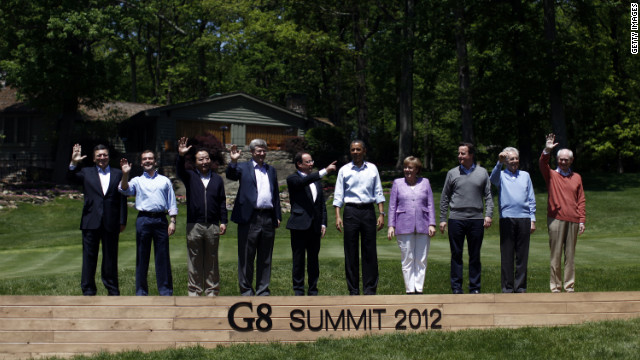
CNN) -- President Barack Obama and fellow leaders at the Group of Eight meeting he hosted Saturday put job creation and economic growth at the top of their to-do list.
"(They) must be our top priority. A stable growing European economy is in everybody's best interest, including the United States'," Obama told reporters after the two-day Camp David retreat in Maryland concluded.
At the same time, leaders stated "that the right measures are not the same for each of us."
The G8 meeting was one of two high-stakes, back-to-back weekend summits scheduled over the weekend. On Sunday, NATO kicks off its two-day summit in Chicago, with a focus on the Afghanistan war.
Authorities announced Saturday that three people were charged with planning violent attacks during the Chicago summit.
The men, termed "self-proclaimed anarchists" by authorities, allegedly conspired to attack Obama's Chicago campaign headquarters, the Chicago mayor's home and police stations, authorities said. An Illinois judge set bail at $1.5 million for each of the three suspects arrested Wednesday.
Summit protesters, including those affiliated with Occupy Chicago, held rallies Saturday.
G8 leaders -- from the United States, France, the United Kingdom, Germany, Japan, Italy, Canada and Russia -- issued a declaration detailing their commitment to ensuring adequate energy and dealing with climate change; providing food security and nutrition in Africa; promoting democratic transitions in the Middle East; and supporting political transition in Syria. They reiterated "grave concern" over Iran's nuclear program and the need to ensure an adequate oil supply.
But it was the global economy dominated that dominated the Camp David sessions.
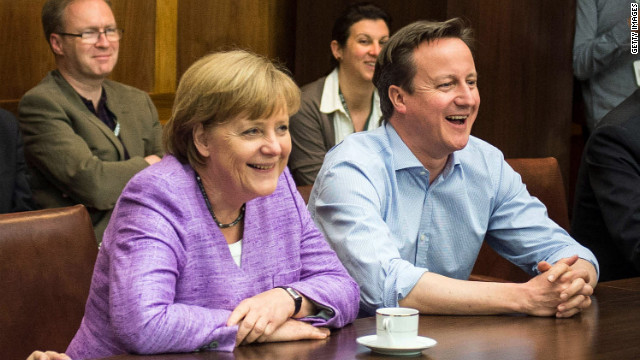
The group dealt with an economically weakened, debt-laden Europe and faced the questions of whether massive deficit cuts trumpeted by German Chancellor Angela Merkel or economic stimulus will help the continent grow its way out of the current crisis. The language in their declaration Saturday appeared to focus as much on growth as austerity.
While discussing economic challenges and progress in the United States, Obama said the eurozone is more complicated.
"There are 17 countries in the eurozone that need to come to an agreement," the president said, citing the crisis affecting Greece and other nations. "Europe has taken significant steps to manage the crisis."
Hanging over the deliberations was the fate of Greece, which has been unable to form an elected government. Many analysts believe that Athens will be forced to exit the eurozone shortly, dropping the euro currency and possibly further rattling economic confidence.
"We welcome the ongoing discussion in Europe on how to generate growth, while maintaining a firm commitment to implement fiscal consolidation to be assessed on a structural basis," the leaders said in a statement.
"We agree on the importance of a strong and cohesive eurozone for global stability and recovery, and we affirm our interest in Greece remaining in the eurozone while respecting its commitments. We all have an interest in the success of specific measures to strengthen the resilience of the eurozone and growth in Europe."
The group also addressed the effects of sanctions on Iran over its nuclear ambitions. Iran says it wants nuclear power for peaceful purposes, but world powers fear that it is working to develop nuclear weaponry.
Tough sanctions on Iran are slated to take effect June 28, and a full embargo of Iranian oil by the European Union is set for July 1. There is concern about whether a sufficient supply of oil and oil products from other countries will make up for a lack of Iranian oil.
"There have been increasing disruptions in the supply of oil to the global market over the past several months, which pose a substantial risk to global economic growth. In response, major producers have increased their output while drawing prudently on excess capacity," the G8 leaders said in a statement. They said they stood ready to call upon the International Energy Agency to take appropriate action to ensure that the market is fully and timely supplied.
Mike Froman, a White House national security adviser for international economic affairs, said the atmosphere at the summit was congenial and there was "very good interaction" among European leaders.
No one was defensive as the leaders shared their perspectives on the need to deal with debt and deficits and the importance of promoting economic growth. That included Merkel, a proponent of tough austerity measures, and newly elected French President Francois Hollande, who has different views on austerity and growth.
There was agreement among the leaders that North Korea faces further isolation if it continues its pursuit of a nuclear program.
Obama said the group believes that a "peaceful resolution and a political transition is preferable" in Syria and the group said it is "deeply concerned about violence and loss of life."
The world leaders support U.N. and Arab League envoy Kofi Annan's six-point peace plan to end the 14-month crisis in Syria, an initiative that calls for a cease-fire. While all of the nations back the Annan plan at the U.N. Security Council, there have been differences between Russia and China and other nations on how to tackle the crisis in Syria.
The United States and other countries have urged Syrian President Bashar al-Assad to step aside and have initiated tough sanctions against the government. Russia and China's stated position is to call for an end to violence, but through diplomacy and negotiation, not official sanctions.
Earlier Saturday, Obama said leaders are hopeful about the dramatic political transition in Myanmar, also known as Burma.
"On a brighter note, we had the opportunity to discuss Burma, and all of us are hopeful that the political process and transition and transformation that is beginning to take place there takes root."
A few hundred activists with ties to Ethiopia protested the invitation of Prime Minister Meles Zenawi to the G8 summit. They rallied in Thurmont, the town nearest Camp David. They decried Zenawi's rule as authoritarian.
On Sunday, the war in Afghanistan is expected to dominate discussions at the NATO summit. Afghan President Hamid Karzai and Pakistani President Asif Zardari are both expected to attend the meeting.
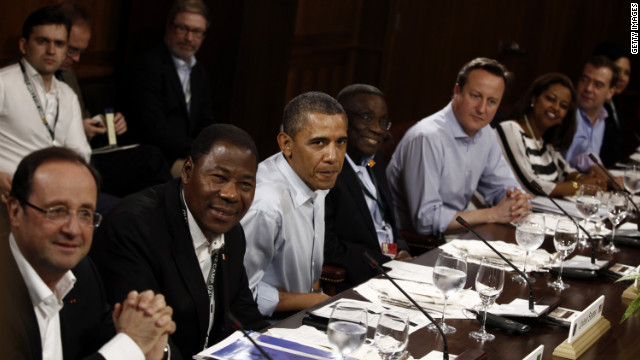
NATO leaders are currently on a timetable to withdraw all of the alliance's combat troops from Afghanistan in 2014.
Senior administration officials tell CNN that NATO members have tentatively agreed on a security transition plan from NATO's International Security Assistance Force to the Afghan National Security Forces before 2014. The plan, which also lays out a NATO training and advisory role after 2014, is expected to be formally adopted at the summit.
One of the key issues to be discussed in Chicago is who will pay to build up Afghan security forces during and after the NATO drawdown. Afghan national security forces should total around 350,000 by 2015, according to CNN National Security Analyst Peter Bergen. Karzai's government can afford to cover only a fraction of the cost, which is expected to total roughly $4 billion annually after 2014, Bergen notes.
Non-U.S. ISAF countries are being asked to come up with $1.3 billion, the officials said.
Another issue is Islamabad's continued blockade of much-needed NATO supplies over Pakistani roads to Afghanistan. Pakistan has kept its airspace open but closed its ground routes after the death of about two dozen Pakistani soldiers in November at the hands of NATO forces at a post on the Afghan-Pakistan border. NATO insists that the incident was an accident. Negotiations on the issue continue, the senior administration officials said.
©CNN's Peter Bergen, Alan Silverleib, Elise Labott, Mike Mount and Ted Rowlands
http://edition.cnn.com/2012/05/19/world/obama-g8-nato/index.html?hpt=hp_t2
Family hangs hope for boy on unproven therapy in India
Family hangs hope for boy on unproven therapy in India
New Delhi (CNN) -- Cash Burnaman, a 6-year-old South Carolina boy, has traveled with his parents to India seeking treatment for a rare genetic condition that has left him developmentally disabled. You might think this was a hopeful mission until you learn that an overwhelming number of medical experts insist the treatment will have zero effect.
Cash is mute. He walks with the aid of braces. To battle his incurable condition, which is so rare it doesn't have a name, Cash has had to take an artificial growth hormone for most of his life.
His divorced parents, Josh Burnaman and Stephanie Krolick, are so driven by their hope and desperation to help Cash they've journeyed to the other side of the globe and paid tens of thousands of dollars to have Cash undergo experimental injections of human embryonic stem cells.
The family is among a growing number of Americans seeking the treatment in India -- some at a clinic in the heart of New Delhi called NuTech Mediworld run by Dr. Geeta Shroff, a retired obstetrician and self-taught embryonic stem cell practitioner.
Shroff first treated Cash -- who presents symptoms similar to Down Syndrome -- in 2010. "I am helping improve their quality of life," Shroff told CNN.
After five weeks of treatment, Cash and his parents returned home to the U.S.
That's when Cash began walking with the aid of braces for the first time.
His parents were thrilled. Before the treatments, Cash could only get around by hopping, his mother said. The results were enough to persuade Cash's mother to go back to Shroff for more help.
"We saw evidence the first time that it's worth trying again," Krolick said. "In this particular case, with Cash's other conditions, we don't have many other options."
For four or five weeks of treatment, Shroff says she has charged her 87 American patients an average of $25,000. It's a big financial hit for Burnaman, a volunteer firefighter and property manager, and Krolick, who attends technical college in Greenville, South Carolina.
But the boy's family and friends went into fundraising mode, creating a blog called ChangeForCash.com, and amassing about $50,000 over a year.
Are patients like Cash truly receiving treatments that improve their quality of life? Or is therapy giving patients false hope?
Doctors say all that work and hope and money Cash's supporters have funneled into his experimental therapy likely will have no medical benefits.
There are several types of stem cells. Adult stem cells can be found in mature cells and some organs. For example, bone marrow cells are a type of adult stem cell that have been used in transplants for more than 40 years. But because adult stem cells are taken from parts of the body that already have a purpose, they may be limited as to what they can be turned into.
Embryonic stem cells are the controversial ones because they're harvested from leftover IVF embryos, which are then destroyed in the process.
Embryonic stem cells come from 4-or 5-day-old fertilized eggs and have the ability to turn into any type of cell in the body.
Since human embryonic stem cells were first discovered in 1998, researchers have been trying to take these unique cells and coax them into becoming cells for every part of the body, which then could be used to repair damage or regenerate tissue.
For many years a virtual ban on funding this type of research slowed the field down.
It's risky medical therapy. But I knew that we were going to have to do it.
Stephanie Krolick, Cash Burnaman's mother
Researchers have developed another source of stem cells: skin cells. Scientists learned to turn the clock back on skin cells so they're like embryos -- with stem cells that have the same "blank slate" properties like embryonic stem cells -- but without the controversy. These cells are called "IPS" (induced pluripotent stem) cells -- and are not yet being used in human experiments.
There are no approved embryonic stem cell treatments in the United States. However, the Food and Drug Administration has approved two experimental clinical trials in humans using treatments made from human embryonic stem cells. One of these -- to repair spinal cord injuries -- was stopped due to the high cost of this type of research; the other trial -- to restore vision in people with macular degeneration -- is still underway.
There is hope that embryonic stem cells might someday lead to treatments for Parkinson's disease, diabetes, traumatic spinal cord injury, Duchenne muscular dystrophy and other conditions, according to the National Institutes of Health. Someday.
Nevertheless, Shroff isn't waiting for further research. She's injecting patients with embryonic stem cells now.
"There is zero evidence for what she is doing being effective," said Rutgers University's Dr. Wise Young, a leading U.S. neuroscientist.
"It's concerning no matter how you look at it," said CNN Chief Medical Correspondent Dr. Sanjay Gupta. "Frankly it's the complete wrong way of going about this sort of science."
Inside her clinic, surrounded by patients, Shroff disagreed.
"Success," she said, "is defined differently by various groups of people within that therapy mode. So as of right now, almost everyone -- greater than 90% -- have had success."
But Cash's family has its doubters, too. The boy's father said he still isn't totally convinced the treatment works.
"If we had taken away the stem cells and hadn't done it, is this where he would be naturally?" Burnaman said. "And that's where I keep coming back to is -- I'm not sure."
"It's risky medical therapy," acknowledged Krolick, who feared it would worsen Cash's condition. "But I knew that we were going to have to do it. We did pick this clinic for a reason. I mean, we did look around, and we decided this is the place where we felt safe. She had a good track record."
An energetic doctor who trained in India, Shroff says she acquired embryonic stem cells with the patient's permission after she performed an in-vitro fertilization procedure on a woman more than a decade ago.
She would not allow CNN access to the facility where she says the embryonic cells are kept and harvested.
Nurses and assistants at NuTech Mediworld routinely inject patients with embryonic stem cells daily simply by sticking the needle into a patient's back.
The routine at the clinic starkly contrasts with procedures CNN observed at a sanctioned embryonic stem cell trial at Atlanta's Emory University, where technicians and surgeons took hours to conduct a safe injection.
NuTech Mediworld's treatment also includes physical therapy. The patient and a guest receive room and board. The rooms are cramped with bathroom facilities available down a long hallway.
Shroff has treated patients suffering from amyotrophic lateral sclerosis or ALS, more commonly known as Lou Gehrig's disease. Others had spinal cord injuries, cerebral palsy, genetic and muscular skeletal disorders.
Pure embryonic stem cells are not meant to be put directly into the body, since they have to the potential to turn into any cell. That's why credible researchers first chemically "coax" these stem cells into heading down the path of what they should turn into -- for example nerve cells or heart cells -- before injecting them into very specific parts of the body to achieve the desired results.
The doctor offered examples of her successes including a man from Baghdad who she said was a paraplegic because of multiple gunshot wounds and an Indian toddler who she said has a genetic disorder similar to Cash's.
Kohl Guffey, an 18-year-old from Illinois who was paralyzed three years ago in a motocross accident, cites himself as another example of success at the clinic.
"Before I came here, I didn't have any movement in my left hand between my fingers," said Guffey. "Now I can retract them really good."
Shroff conceded that when she attempted to present her findings to an internationally sanctioned stem cell conference, her medical abstract paperwork was rejected. But she continues to defend her work. "I believe that my patients are getting better," she said. "I have proved it time and time and time again."
She was present at a recent meeting of the Indian Council of Medical Research where prominent Indian physicians criticized embryonic stem cell clinics that have appeared in New Delhi and elsewhere throughout the sprawling country.
A leading Indian neurosurgeon, Dr. P.N. Tandon, agreed there was zero medical evidence of the effectiveness of embryonic stem cell therapy like that provided at NuTech Mediworld. There is no stem cell treatment proven in India that will make patients like these better, Tandon said, and none "proven anywhere in the world."
Patients also have traveled for similar therapy in Central America, Mexico and China, although that country has recently clamped down on stem cell clinics.
For Young, the money charged for the therapy stands out as an ethical issue. "It's all about $25,000," he said. The cost of the treatment is "calculated to take a family to the brink of what they can afford, and they take everything."
"Who doesn't want to get rich?" Shroff asked. "Who doesn't work for money? But you also have to work from the heart. You also have to see what you're doing. Is it ethically right? And I believe I am doing everything right."
©CNN Medical Managing Editor Miriam Falco
http://edition.cnn.com/2012/05/19/health/embryonic-stem-cell-therapy/index.html?hpt=hp_c2
New Delhi (CNN) -- Cash Burnaman, a 6-year-old South Carolina boy, has traveled with his parents to India seeking treatment for a rare genetic condition that has left him developmentally disabled. You might think this was a hopeful mission until you learn that an overwhelming number of medical experts insist the treatment will have zero effect.
Cash is mute. He walks with the aid of braces. To battle his incurable condition, which is so rare it doesn't have a name, Cash has had to take an artificial growth hormone for most of his life.
His divorced parents, Josh Burnaman and Stephanie Krolick, are so driven by their hope and desperation to help Cash they've journeyed to the other side of the globe and paid tens of thousands of dollars to have Cash undergo experimental injections of human embryonic stem cells.
The family is among a growing number of Americans seeking the treatment in India -- some at a clinic in the heart of New Delhi called NuTech Mediworld run by Dr. Geeta Shroff, a retired obstetrician and self-taught embryonic stem cell practitioner.
Shroff first treated Cash -- who presents symptoms similar to Down Syndrome -- in 2010. "I am helping improve their quality of life," Shroff told CNN.
After five weeks of treatment, Cash and his parents returned home to the U.S.
That's when Cash began walking with the aid of braces for the first time.
His parents were thrilled. Before the treatments, Cash could only get around by hopping, his mother said. The results were enough to persuade Cash's mother to go back to Shroff for more help.
"We saw evidence the first time that it's worth trying again," Krolick said. "In this particular case, with Cash's other conditions, we don't have many other options."
For four or five weeks of treatment, Shroff says she has charged her 87 American patients an average of $25,000. It's a big financial hit for Burnaman, a volunteer firefighter and property manager, and Krolick, who attends technical college in Greenville, South Carolina.
But the boy's family and friends went into fundraising mode, creating a blog called ChangeForCash.com, and amassing about $50,000 over a year.
Are patients like Cash truly receiving treatments that improve their quality of life? Or is therapy giving patients false hope?
Doctors say all that work and hope and money Cash's supporters have funneled into his experimental therapy likely will have no medical benefits.
There are several types of stem cells. Adult stem cells can be found in mature cells and some organs. For example, bone marrow cells are a type of adult stem cell that have been used in transplants for more than 40 years. But because adult stem cells are taken from parts of the body that already have a purpose, they may be limited as to what they can be turned into.
Embryonic stem cells are the controversial ones because they're harvested from leftover IVF embryos, which are then destroyed in the process.
Embryonic stem cells come from 4-or 5-day-old fertilized eggs and have the ability to turn into any type of cell in the body.
Since human embryonic stem cells were first discovered in 1998, researchers have been trying to take these unique cells and coax them into becoming cells for every part of the body, which then could be used to repair damage or regenerate tissue.
For many years a virtual ban on funding this type of research slowed the field down.
It's risky medical therapy. But I knew that we were going to have to do it.
Stephanie Krolick, Cash Burnaman's mother
Researchers have developed another source of stem cells: skin cells. Scientists learned to turn the clock back on skin cells so they're like embryos -- with stem cells that have the same "blank slate" properties like embryonic stem cells -- but without the controversy. These cells are called "IPS" (induced pluripotent stem) cells -- and are not yet being used in human experiments.
There are no approved embryonic stem cell treatments in the United States. However, the Food and Drug Administration has approved two experimental clinical trials in humans using treatments made from human embryonic stem cells. One of these -- to repair spinal cord injuries -- was stopped due to the high cost of this type of research; the other trial -- to restore vision in people with macular degeneration -- is still underway.
There is hope that embryonic stem cells might someday lead to treatments for Parkinson's disease, diabetes, traumatic spinal cord injury, Duchenne muscular dystrophy and other conditions, according to the National Institutes of Health. Someday.
Nevertheless, Shroff isn't waiting for further research. She's injecting patients with embryonic stem cells now.
"There is zero evidence for what she is doing being effective," said Rutgers University's Dr. Wise Young, a leading U.S. neuroscientist.
"It's concerning no matter how you look at it," said CNN Chief Medical Correspondent Dr. Sanjay Gupta. "Frankly it's the complete wrong way of going about this sort of science."
Inside her clinic, surrounded by patients, Shroff disagreed.
"Success," she said, "is defined differently by various groups of people within that therapy mode. So as of right now, almost everyone -- greater than 90% -- have had success."
But Cash's family has its doubters, too. The boy's father said he still isn't totally convinced the treatment works.
"If we had taken away the stem cells and hadn't done it, is this where he would be naturally?" Burnaman said. "And that's where I keep coming back to is -- I'm not sure."
"It's risky medical therapy," acknowledged Krolick, who feared it would worsen Cash's condition. "But I knew that we were going to have to do it. We did pick this clinic for a reason. I mean, we did look around, and we decided this is the place where we felt safe. She had a good track record."
An energetic doctor who trained in India, Shroff says she acquired embryonic stem cells with the patient's permission after she performed an in-vitro fertilization procedure on a woman more than a decade ago.
She would not allow CNN access to the facility where she says the embryonic cells are kept and harvested.
Nurses and assistants at NuTech Mediworld routinely inject patients with embryonic stem cells daily simply by sticking the needle into a patient's back.
The routine at the clinic starkly contrasts with procedures CNN observed at a sanctioned embryonic stem cell trial at Atlanta's Emory University, where technicians and surgeons took hours to conduct a safe injection.
NuTech Mediworld's treatment also includes physical therapy. The patient and a guest receive room and board. The rooms are cramped with bathroom facilities available down a long hallway.
Shroff has treated patients suffering from amyotrophic lateral sclerosis or ALS, more commonly known as Lou Gehrig's disease. Others had spinal cord injuries, cerebral palsy, genetic and muscular skeletal disorders.
Pure embryonic stem cells are not meant to be put directly into the body, since they have to the potential to turn into any cell. That's why credible researchers first chemically "coax" these stem cells into heading down the path of what they should turn into -- for example nerve cells or heart cells -- before injecting them into very specific parts of the body to achieve the desired results.
The doctor offered examples of her successes including a man from Baghdad who she said was a paraplegic because of multiple gunshot wounds and an Indian toddler who she said has a genetic disorder similar to Cash's.
Kohl Guffey, an 18-year-old from Illinois who was paralyzed three years ago in a motocross accident, cites himself as another example of success at the clinic.
"Before I came here, I didn't have any movement in my left hand between my fingers," said Guffey. "Now I can retract them really good."
Shroff conceded that when she attempted to present her findings to an internationally sanctioned stem cell conference, her medical abstract paperwork was rejected. But she continues to defend her work. "I believe that my patients are getting better," she said. "I have proved it time and time and time again."
She was present at a recent meeting of the Indian Council of Medical Research where prominent Indian physicians criticized embryonic stem cell clinics that have appeared in New Delhi and elsewhere throughout the sprawling country.
A leading Indian neurosurgeon, Dr. P.N. Tandon, agreed there was zero medical evidence of the effectiveness of embryonic stem cell therapy like that provided at NuTech Mediworld. There is no stem cell treatment proven in India that will make patients like these better, Tandon said, and none "proven anywhere in the world."
Patients also have traveled for similar therapy in Central America, Mexico and China, although that country has recently clamped down on stem cell clinics.
For Young, the money charged for the therapy stands out as an ethical issue. "It's all about $25,000," he said. The cost of the treatment is "calculated to take a family to the brink of what they can afford, and they take everything."
"Who doesn't want to get rich?" Shroff asked. "Who doesn't work for money? But you also have to work from the heart. You also have to see what you're doing. Is it ethically right? And I believe I am doing everything right."
©CNN Medical Managing Editor Miriam Falco
http://edition.cnn.com/2012/05/19/health/embryonic-stem-cell-therapy/index.html?hpt=hp_c2
Subscribe to:
Posts (Atom)
